
The LottoExpert methodology
SKAI Precision Lock™
SKAI Precision Lock™ is LottoExpert's settings optimization methodology. It helps users start with a broader analytical view, compare what holds up, remove weaker directions, and lock onto the most efficient and consistent setting range with disciplined evidence instead of guesswork.
Visual explanation
The Precision Lock System at a glance
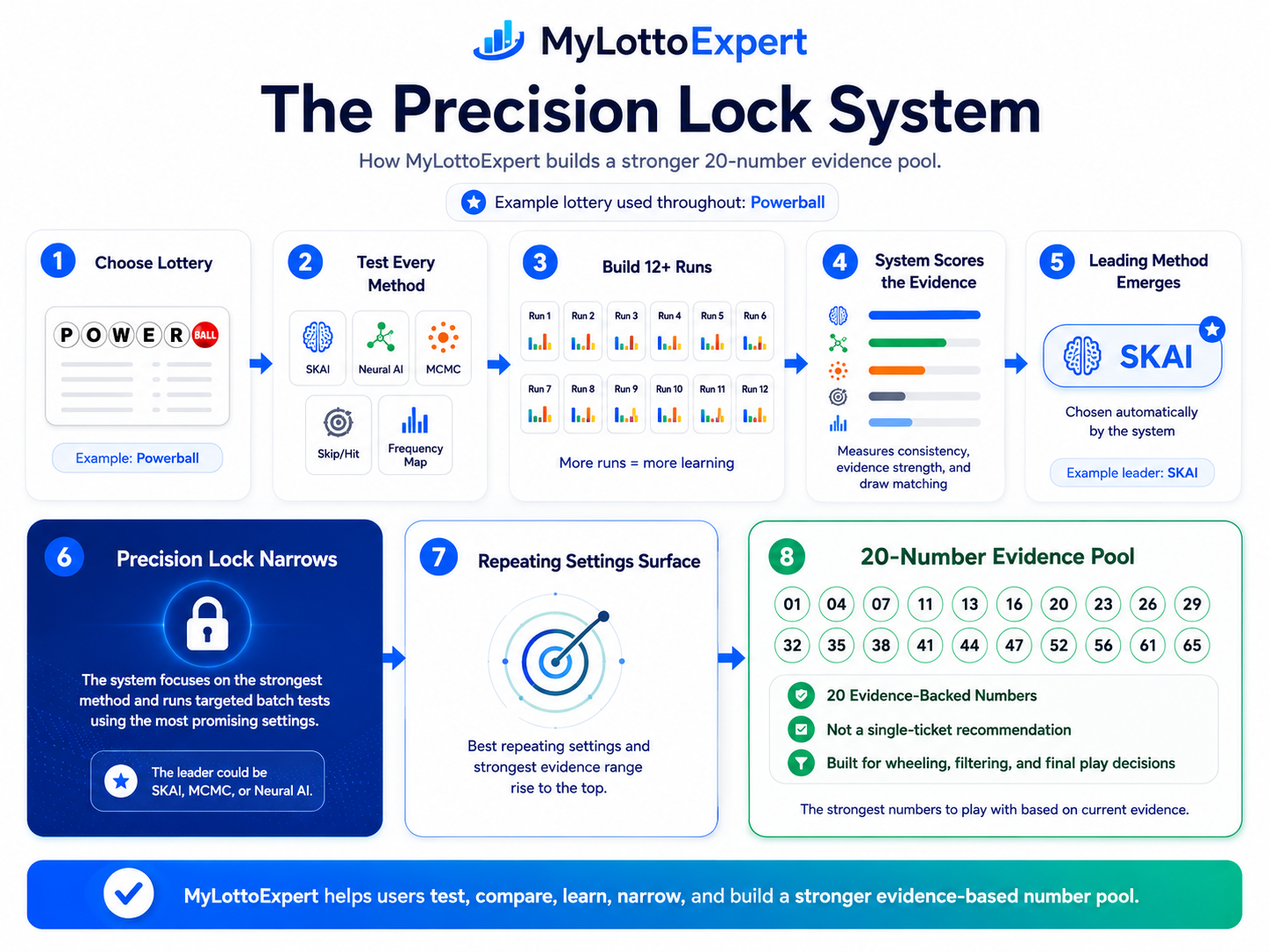
This system diagram shows how MyLottoExpert starts broad, tests every method, learns from repeated runs, lets the leading method emerge automatically, and narrows toward a stronger 20-number evidence pool.
Why this exists
Do not jump too fast to one setting
Many users make the same mistake. They try to find the best setting too early. That usually leads to noise, confusion, and too many random changes. SKAI Precision Lock™ creates a better path. You begin with a wider view, let the evidence build, and then narrow down step by step toward the settings that show the best balance of efficiency and consistency.
The Precision Lock™ flow
Test every method
Start broad with SKAI, Neural AI, MCMC, Skip/Hit, and Frequency Map instead of assuming one method is best too early.
Build 12+ runs
More quality runs give the system more evidence to compare, score, and learn from over time.
Let the system compare
MyLottoExpert evaluates consistency, evidence strength, draw matching, and repeated support across saved runs.
Narrow with Precision Lock™
Once a leading method emerges, the system focuses on the strongest settings and tests them more carefully.
Build the number pool
The final goal is a stronger 20-number evidence pool for wheeling, filtering, and final play decisions.
How all the tools work together
LottoExpert works best when the tools are not treated as separate islands. Each one helps with a different part of the Precision Lock™ process.
- SKAI helps identify and lock onto the strongest setting direction.
- Skip & Hit helps you read the rhythm and behavior of the draw history.
- Lowest Threshold can help show where certain behaviors become more meaningful.
- My LottoExpert keeps the record of what you tested and how it behaved.
When these tools are used together, the system becomes much more useful. You stop guessing from one page at a time and start working through a controlled optimization process.
Why SKAI is the flagship
SKAI is the flagship analysis engine because it is the main environment where Precision Lock™ comes to life. It is where broad testing, comparison, refinement, and setting discipline can work together.
The other tools still matter. They help confirm what you are seeing, challenge weak ideas, and add context. But once a direction starts standing out, SKAI becomes the primary place where deeper refinement begins.
Why the 9-run combinations matter
The 9-run combinations support the wider screening stage. Their job is not to finish the process. Their job is to help you compare more directions early on.
This gives you a better chance to see which blend family looks more promising before you spend time fine-tuning one setup. In simple terms, the 9 runs help Precision Lock™ ask a smarter question first:
Which blend direction deserves more attention?
Refine the blend and skip relationship
After a stronger direction appears, the next step is not to change everything at once. The next step is to refine the blend and skip relationship.
For example, if a balanced training style and a balanced-with-skip behavior start looking stronger, that becomes the area to test more carefully. Now you are no longer asking, "What should I try?" Now you are asking:
Where is the most repeatable performance balance?
Refine in the right order
The order matters. First, identify the strongest broad direction. Next, refine the blend and skip behavior. After that, move into advanced settings. Precision Lock™ keeps the process clean. If you jump into advanced controls too early, you may end up tuning details inside a setup that never deserved deeper attention in the first place.
When to use advanced settings
Advanced settings are important, but timing matters. They make the most sense after you already know which broader setup is more likely to be worth refining.
- test one major change at a time when possible
- compare results instead of reacting to one strong run
- use epochs and custom controls to sharpen a promising setup, not rescue a weak one
In other words, advanced settings should improve a strong direction, not create one out of thin air.
Why My LottoExpert matters so much
My LottoExpert is where the real learning happens. It gives you a way to track runs, compare history, and see what is building confidence over time.
Without tracking, it is easy to chase short-term excitement. With tracking, you can separate:
- what looked good once
- what keeps showing up with strength
- what truly deserves more serious attention
Precision Lock™ is discipline, not a shortcut
This approach takes work. It asks for patience, comparison, and honest review. The point is not to create hype. The point is to help you become more disciplined about what deserves trust. When a setup continues to hold up after careful testing, that is when a user can begin approaching it more seriously.
Use Precision Lock™ as a system, not as a single setting
The real strength of LottoExpert is not one setting or one screen. It is the process. Start broad. Narrow with evidence. Lock onto what earns confidence. Then track it over time.
SKAI Precision Lock™ is a decision-support methodology. It does not guarantee lottery outcomes.